A Practical Guide to Language Assessment

Autores/as

Eliana Geomar León-Abad, Universidad Estatal Península de Santa Elena | Santa Elena | Ecuador; Rudy Jonathan Párraga Solórzano, Universidad Estatal Península de Santa Elena | Santa Elena | Ecuador; Heidy Bolivia Matute Campozano, Universidad Nacional de Educación | Cuenca | Ecuador; Rosa Elena Niola Sanmartín, Universidad Estatal Península de Santa Elena | Santa Elena | Ecuador; María Gabriela Gándara Vivar, Universidad Estatal Península de Santa Elena | Santa Elena | Ecuador

Palabras clave:

Language Assessment; Evaluation; TEFL; English skills.

Sinopsis

This book on Language Assessment provides a comprehensive exploration of essential topics that contribute to the effective training of students and teachers in English and other foreign languages.

Descargas

Los datos de descarga aún no están disponibles.

Biografía del autor/a

Eliana Geomar León-Abad, Universidad Estatal Península de Santa Elena | Santa Elena | Ecuador

Teacher with +18 years’ experience teaching children, teenagers, and adults; with a passion for education and a strong commitment to optimizing student and academy success. She’s been tutoring undergraduate degree thesis and has served as a trainer in English language certifications. She is also part of a team of translators in administrative, legal, e-commerce, websites, and government projects. She has conducted research related to language teaching and assessment. Currently, her doctoral studies in Education and Innovation keep her abreast of the most current research and practices in the field.

Rudy Jonathan Párraga Solórzano, Universidad Estatal Península de Santa Elena | Santa Elena | Ecuador

He is a professor with over 10 years of experience in teaching English as a foreign language. He is currently a doctoral candidate in Education and focuses his academic work on language pedagogy, curriculum development, and innovative teaching methodologies. His research interests include English language teaching, educational psychology, and reflective teaching practices in higher education.

Heidy Bolivia Matute Campozano, Universidad Nacional de Educación | Cuenca | Ecuador

Professor at the National University of Education in Ecuador, focuses on professional development for EFL educators. Her expertise is evidenced by her experience in developing and coordinating impactful outreach and research projects such as PRELIM 2 and 3 in collaboration with the British Council. She holds a Master's in English Language and Applied Linguistics and is an internationally CELTA certified teacher. Currently, a PhD candidate in Higher Education, and collaborated as moderator in the project, "Let's Go Green," integrating environmental sustainability into English language teaching, engaging over 54 teachers globally through the EVO network in TESOL.

Rosa Elena Niola Sanmartín, Universidad Estatal Península de Santa Elena | Santa Elena | Ecuador

Teacher committed to education, transformation of society, and development. With 13 years of experience in teaching English and Spanish, has developed her expertise in the teaching field in different levels such as primary, secondary, and higher education. Holding a B.A. in Educational Sciences, with specialization in English Language, also a Master’s degree in English Language and Applied Linguistics, at the University of Cuenca. Currently, pursuing a PhD degree in Higher Education at the University of Palermo. Professor for Pedagogy of National and Foreign Languages at UPSE, training future English teachers; participant in research projects, pre teaching service activities, preparation courses for English proficiency exams.

María Gabriela Gándara Vivar, Universidad Estatal Península de Santa Elena | Santa Elena | Ecuador

Passionate and dedicated educator who believes that learning flourishes in safe, respectful, and inclusive environments. She prioritizes creating a classroom culture where students feel seen, valued, and supported. A strong advocate of integral education, she integrates literacy development with essential skills and core values in her lesson planning. María Gabriela enjoys fostering teamwork, collaboration, and critical thinking through dynamic, student-centered activities. She sees education as a transformative journey that empowers learners beyond academics. She currently teaches at the Universidad Estatal Península de Santa Elena and is committed to meaningful, holistic teaching practices.

Referencias

Alternative ways to revise. (2024, 16 of april). WHATUNI? https://n9.cl/sq1w3

Astorga, E. D. (2015). The relationship between listening proficiency and speaking improvement in Higher education: Considerations in Assessing Speaking and listening. Higher Learning Research Communications, 5(2), 34. https://doi.org/10.18870/hlrc.v5i2.236

Brindley, G. (1998). Assessing listening abilities. Annual Review of Applied Linguistics, 18, 171–191. https://doi.org/10.1017/s0267190500003536

Brookhart, S. M., & Chen, F. (2014). The quality and effectiveness of descriptive rubrics. Educational Review, 67(3), 343–368. https://doi.org/10.1080/00131911.2014.929565

Busayo.Longe. (2021, 23 of july). Assessment vs Evaluation: 11 Key Differences. FormPlus. https://www.formpl.us/blog/assessment-vs-evaluation

Callcenter-5. (2025). Speechace Speaking Test. https://n9.cl/bm9ypm

Finish Education evaluation centre. (n.d.). 1.3 The evaluation and enhancement of education – Korkeakouluauditoinnit. https://n9.cl/iidhbs

Formative and summative assessments. (2021, 30 of june). Poorvu Center for Teaching and Learning. https://poorvucenter.yale.edu/Formative-Summative-Assessments

Gafforov, I., & Abdulkhay, K. (2022). The role of assessment in language teaching. International Journal of Inclusive and Sustainable Education, 1(4), 31–34. https://doi.org/10.51699/ijise.v1i4.139

Frank, J. (2012). The Roles of Assessment in Language Teaching. English Teaching Forum, 50(3), 32. https://americanenglish.state.gov/forum

Harlen, W., & James, M. (1997). Assessment and Learning: differences and relationships between formative and summative assessment. Assessment in Education Principles Policy and Practice, 4(3), 365–379. https://doi.org/10.1080/0969594970040304

Javed, M., Juan, W. X., & Nazli, S. (2012). A study of students’ assessment in writing skills of the English language. Jurnal Obsesi: Jurnal Pendidikan Anak Usia Dini, 1(1), 65–73.

Joshi, R. M. (1995). Assessing reading and spelling skills. School Psychology Review, 24(3), 361–375. https://doi.org/10.1080/02796015.1995.12085774

Lms, E. (2024, 16 of may). Assessment vs Evaluation: what’s the difference? https://n9.cl/joo82

Mead, N. A., & Rubin, D. L. (n.d.). Assessing listening and speaking skills. ERIC digest. https://eric.ed.gov/?id=ED263626

Phelps, G., & Bridgeman, B. (2022). From knowing to doing: assessing the skills used to teach reading and writing. Reading and Writing, 35(9), 2023–2048. https://doi.org/10.1007/s11145-022-10278-2

Richards, A. S., & Fink, E. L. (2017). Attributional Chromatics: How does the color of written communication affect interpersonal perceptions? International Journal of Communication, 11. https://africaneditors.org/journal/IJC/full-text-pdf/AF806842206

Spinelli, C. G. (2007). Introduction: The benefits, uses, and practical application of informal assessment procedures. Reading & Writing Quarterly, 24(1), 1–6. https://doi.org/10.1080/10573560701753005

Talkpal. (n.d.). Talkpal for Education [Video]. YouTube. https://www.youtube.com/watch?v=wZXdJmbDj9Y
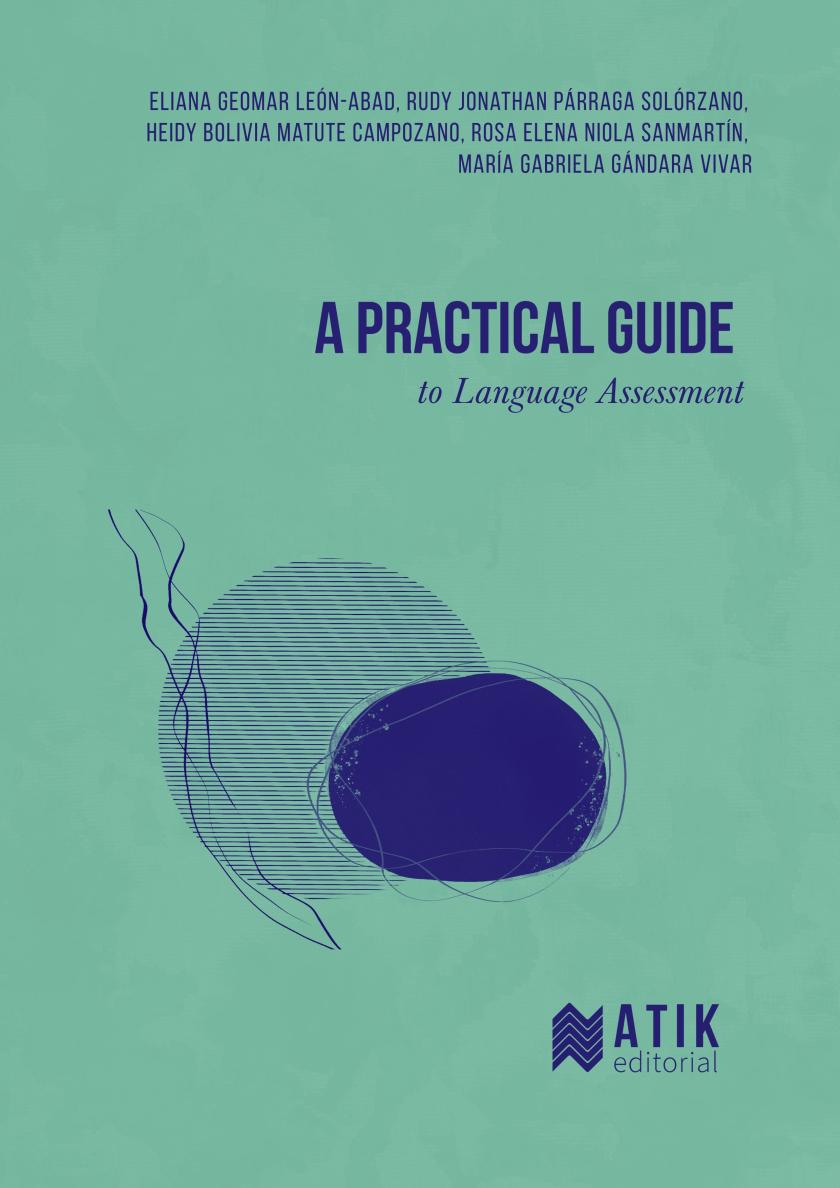
A Practical Guide to Language Assessment

Descargas

Publicado

8 December 2025

Colección

Licencia

Creative Commons License

Esta obra está bajo una licencia internacional Creative Commons Atribución 4.0.

Detalles sobre el formato de publicación disponible: PDF

PDF

ISBN-13 (15)

978-9942-7331-8-4

Fecha de publicación (01)

2025-12-08

Cómo citar

León-Abad, E. G., Párraga Solórzano, R. J., Matute Campozano, H. B., Niola Sanmartín, R. E., & Gándara Vivar, M. G. (2025). A Practical Guide to Language Assessment. Atik Editorial. https://doi.org/10.46652/atikbook16