
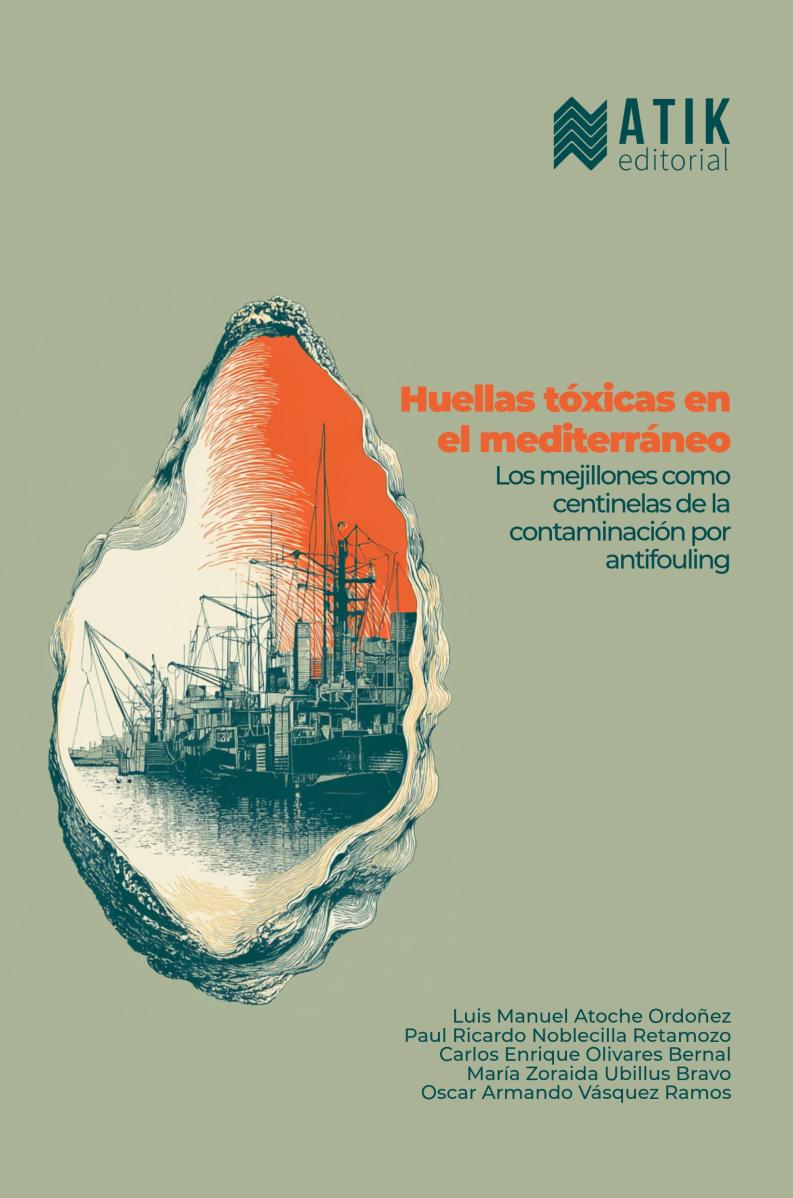
Toxic Traces in the Mediterranean. Mussels as Sentinels of Antifouling Contamination
Keywords:
Antifouling; marine pollution; mussels; heavy metals; bioindicatorsSynopsis
Since the mid-twentieth century, organotin compounds such as tributyltin revolutionized the protection of ship hulls, yet their legacy persists decades after their global prohibition. This book explores contamination by antifouling paints in the Mediterranean, using mussels as environmental sentinels. Through the analysis of metals such as copper and zinc accumulated in these filter-feeding organisms, it reveals how ports and marinas concentrate alarming levels of toxic substances that alter mollusk reproduction and threaten entire ecosystems. An essential work for understanding the invisible impact of nautical activity and the urgency of developing control strategies to achieve good environmental status in our coastal waters.
Downloads
Download data is not yet available.
References
Abbott, A., Abel, P. D., Arnold, D. W., & Milne, A. (2000). Cost-benefit analysis of the use of TBT: The case for a treatment approach. Science of the Total Environment, 258(1-2), 5-19. https://doi.org/10.1016/S0048-9697(00)00505-2
Atoche Ordoñez, L. M. (2017). Niveles de metales en mejillones procedentes de instalaciones portuarias [Tesis de maestría, Universidad Politecnica de Valencia].
Baumard, P., Budzinski, H., & Garrigues, P. (1998). Polycyclic aromatic hydrocarbons in sediments and mussels of the western Mediterranean sea. Environmental Toxicology and Chemistry, 17(5), 765-776. https://doi.org/10.1002/etc.5620170501
Benali, I., Boutiba, Z., Grandjean, D., de Alencastro, L. F., Rouane-Hacene, O., & Chèvre, N. (2017). Spatial distribution and biological effects of trace metals (Cu, Zn, Pb, Cd) and organic micropollutants (PCBs, PAHs) in mussels Mytilus galloprovincialis along the Algerian west coast. Marine Pollution Bulletin, 115(1-2), 539-550. https://doi.org/10.1016/j.marpolbul.2016.12.028
Benedicto, J., Rodríguez, C., Martínez-Gómez, C., Guerrero, J., & Jornet, A. (2003). Distribución espacial y tendencias temporales de los niveles de metales traza en el litoral de Andalucía utilizando mejillón Mytilus galloprovincialis Lamarck, 1819 como organismo indicador: 1991-2003. Boletin - Instituto Espanol de Oceanografia, 19(1-4), 31-39.
Besada, V., Manuel Andrade, J., Schultze, F., & José González, J. (2011). Monitoring of heavy metals in wild mussels (Mytilus galloprovincialis) from the Spanish North-Atlantic coast. Continental Shelf Research, 31(5), 457-465. https://doi.org/10.1016/j.csr.2010.04.011
Bocchetti, R., Fattorini, D., Pisanelli, B., Macchia, S., Oliviero, L., Pilato, F., & Regoli, F. (2008). Contaminant accumulation and biomarker responses in caged mussels, Mytilus galloprovincialis, to evaluate bioavailability and toxicological effects of remobilized chemicals during dredging and disposal operations in harbour areas. Aquatic Toxicology, 89(4), 257-266. https://doi.org/10.1016/j.aquatox.2008.07.011
Borković, S. S., Šaponjić, J. S., Pavlović, S. Z., Blagojević, D. P., Milošević, S. M., Kovačević, T. B., & Saičić, Z. S. (2005). The activity of antioxidant defence enzymes in the mussel Mytilus galloprovincialis from the Adriatic Sea. Comparative Biochemistry and Physiology Part C: Toxicology & Pharmacology, 141(4), 366-374. https://doi.org/10.1016/j.cbpc.2005.08.001
Bresler, V., & Fishelson, L. (1994). Microfluorometrical study of bioaccumulation of benzo(a)pyrene and marker xenobiotics in the bivalve Donax trunculus from clean and polluted sites along the Mediterranean shore of Israel. Diseases of Aquatic Organisms, 19, 193-202.
Burridge, L., Weis, J. S., Cabello, F., Pizarro, J., & Bostick, K. (2010). Chemical use in salmon aquaculture: A review of current practices and possible environmental effects. Aquaculture, 306(1-4), 7-23. https://doi.org/10.1016/j.aquaculture.2010.05.020
Cajaraville, M. P., Bebianno, M. J., Blasco, J., Porte, C., Sarasquete, C., & Viarengo, A. (2000). The use of biomarkers to assess the impact of pollution in coastal environments of the Iberian Peninsula: A practical approach. Science of the Total Environment, 247, 295-311. https://doi.org/10.1016/S0048-9697(99)00499-4
Cantillo, A. E. (1998). Comparison of results of Mussel Watch Programs of the United States and France with Worldwide Mussel Watch Studies. Marine Pollution Bulletin, 36(9), 712-717. https://doi.org/10.1016/S0025-326X(98)00049-6
Cao, S., Wang, J., Chen, H., & Chen, D. (2011). Progress of marine biofouling and antifouling technologies. Chinese Science Bulletin, 56(7), 598-612. https://doi.org/10.1007/s11434-010-4158-4
Carić, H., Klobučar, G., & Štambuk, A. (2016). Ecotoxicological risk assessment of antifouling emissions in a cruise ship port. Journal of Cleaner Production, 121, 159-168. https://doi.org/10.1016/j.jclepro.2014.08.072
Champ, M. A. (2000). A review of organotin regulatory strategies, pending actions, related costs and benefits. Science of the Total Environment, 258(1-2), 21-71. https://doi.org/10.1016/S0048-9697(00)00506-4
Chemicals, U. N. E. (2002). Regionally based assessment of persistent toxic substances. Regional report. Programme des Nations Unies pour l’environnement.
Chong, K., & Wang, W.-X. (2001). Comparative studies on the biokinetics of Cd, Cr, and Zn in the green mussel Perna viridis and the Manila clam Ruditapes philippinarum. Environmental Pollution, 115(1), 107-121. https://doi.org/10.1016/S0269-7491(01)00087-2
Cubadda, F., Conti, M. E., & Campanella, L. (2001). Size-dependent concentrations of trace metals in four Mediterranean gastropods. Chemosphere, 45(4-5), 561-569. https://doi.org/10.1016/S0045-6535(01)00013-3
Dafforn, K. A., Lewis, J. A., & Johnston, E. L. (2011). Antifouling strategies: History and regulation, ecological impacts and mitigation. Marine Pollution Bulletin, 62(3), 453-465. https://doi.org/10.1016/j.marpolbul.2011.01.012
Deudero, S., Box, A., March, D., Valencia, J. M., Grau, A. M., Tintore, J., & Benedicto, J. (2007). Temporal trends of metals in benthic invertebrate species from the Balearic Islands, Western Mediterranean. Marine Pollution Bulletin, 54(9), 1545-1558. https://doi.org/10.1016/j.marpolbul.2007.05.012
Fitridge, I., Dempster, T., Guenther, J., & de Nys, R. (2012). The impact and control of biofouling in marine aquaculture: A review. Biofouling, 28(7), 649-669. https://doi.org/10.1080/08927014.2012.700478
Frenzilli, G., Nigro, M., Scarcelli, V., Gorbi, S., & Regoli, F. (2001). DNA integrity and total oxyradical scavenging capacity in the Mediterranean mussel, Mytilus galloprovincialis: A field study in a highly eutrophicated coastal lagoon. Aquatic Toxicology, 53(1), 19-32. https://doi.org/10.1016/S0166-445X(00)00159-4
Furdek, M., Vahčič, M., Ščančar, J., Milačič, R., Kniewald, G., & Mikac, N. (2012). Organotin compounds in seawater and Mytilus galloprovincialis mussels along the Croatian Adriatic Coast. Marine Pollution Bulletin, 64(2), 189-199. https://doi.org/10.1016/j.marpolbul.2011.12.009
Garaventa, F., Pellizzato, F., Faimali, M., Terlizzi, A., Medakovic, D., Geraci, S., & Pavoni, B. (2006). Imposex in Hexaplex trunculus at some sites on the North Mediterranean Coast as a base-line for future evaluation of the effectiveness of the total ban on organotin based antifouling paints. Hydrobiologia, 555(1), 281-287. https://doi.org/10.1007/s10750-005-1124-2
Georgopoulos, G., Roy, A., Yonone-Lioy, M. J., Opiekun, R. E., & Lioy, P. J. (2001). Environmental copper: Its dynamics and human exposure issues. Journal of Toxicology and Environmental Health, Part B, 4(4), 341-394. https://doi.org/10.1080/109374001753146207
Gipperth, L. (2009). The legal design of the international and European Union ban on tributyltin antifouling paint: Direct and indirect effects. Journal of Environmental Management, 90(1), S86-S95. https://doi.org/10.1016/j.jenvman.2008.08.013
Gray, J. S. (1992). Biological and ecological effects of marine pollutants and their detection. Marine Pollution Bulletin, 25(1-4), 48-50. https://doi.org/10.1016/0025-326X(92)90184-8
Guardiola, F. A., Cuesta, A., Meseguer, J., & Esteban, M. A. (2012). Risks of using antifouling biocides in aquaculture. International Journal of Molecular Sciences, 13(2), 1541-1560. https://doi.org/10.3390/ijms13021541
Guevara-Riba, A., Sahuquillo, A., Rubio, R., & Rauret, G. (2004). Assessment of metal mobility in dredged harbour sediments from Barcelona, Spain. Science of the Total Environment, 321(1-3), 241-255. https://doi.org/10.1016/j.scitotenv.2003.08.021
Joksimović, D., Kljajić, Z., & Stanković, S. (2012). Concentrations of heavy metals (Zn, Cu, Pb, Cd and As) in the Mediterranean mussel Mytilus galloprovincialis from the Montenegrin coast of the southeastern Adriatic Sea. Water Research and Management, 2(3), 3-9.
Jones, B., & Bolam, T. (2007). Copper speciation survey from UK marinas, harbours and estuaries. Marine Pollution Bulletin, 54(8), 1127-1138. https://doi.org/10.1016/j.marpolbul.2007.04.021
Jović, M., & Stanković, S. (2014). Human exposure to trace metals and possible public health risks via consumption of mussels Mytilus galloprovincialis from the Adriatic coastal area. Food and Chemical Toxicology, 70, 241-251. https://doi.org/10.1016/j.fct.2014.05.012
Karlsson, J., Ytreberg, E., & Eklund, B. (2010). Toxicity of anti-fouling paints for use on ships and leisure boats to non-target organisms representing three trophic levels. Environmental Pollution, 158(3), 681-687. https://doi.org/10.1016/j.envpol.2009.10.024
Kiaune, L., & Singhasemanon, N. (2011). Pesticidal copper(I) oxide: Environmental fate and aquatic toxicity. In Reviews of Environmental Contamination and Toxicology (pp. 1-26). Springer. https://doi.org/10.1007/978-1-4419-9860-6_1
Lau, P. S., & Wong, H. L. (2003). Effect of size, tissue parts and location on six biochemical markers in the green-lipped mussel, Perna viridis. Marine Pollution Bulletin, 46(12), 1563-1572. https://doi.org/10.1016/S0025-326X(03)00321-7
Lewis, J. A. (1998). Marine biofouling and its prevention on underwater surfaces. Materials Forum, 22, 41-61.
Löschau, M., & Krätke, R. (2005). Efficacy and toxicity of self-polishing biocide-free antifouling paints. Environmental Pollution, 138(2), 260-267. https://doi.org/10.1016/j.envpol.2005.04.015
Manduzio, H., Monsinjon, T., Galap, C., Leboulenger, F., & Rocher, B. (2004). Seasonal variations in antioxidant defences in blue mussels Mytilus edulis collected from a polluted area: Major contributions in gills of an inducible isoform of Cu/Zn-superoxide dismutase and of glutathione S-transferase. Aquatic Toxicology, 70(1), 83-93. https://doi.org/10.1016/j.aquatox.2004.07.003
Martínez Guijarro, R., Romero, I., & Pachés, M. (2015). A coastal pollution study: Heavy metal content in marine bivalves from the Spanish Mediterranean. Journal of Environmental Protection, 5(4), 247-257.
Matthiessen, P., Reed, J., & Johnson, M. (1999). Sources and potential effects of copper and zinc concentrations in the estuarine waters of Essex and Suffolk, United Kingdom. Marine Pollution Bulletin, 38(10), 908-920. https://doi.org/10.1016/S0025-326X(99)00090-9
Moore, M. N. (1985). Cellular responses to pollutants. Marine Pollution Bulletin, 16(4), 134-139. https://doi.org/10.1016/0025-326X(85)90003-7
Moore, M. N. (1988). Cytochemical responses of the lysosomal system and NADPH-ferrihemoprotein reductase in molluscan digestive cells to environmental and experimental exposure to xenobiotics. Marine Ecology Progress Series, 46, 81-89. https://doi.org/10.3354/meps046081
Moore, M. N. (1993). Biomarkers of contaminant exposure and effect: A way forward in marine environmental toxicology. Science of the Total Environment, 134(2), 1335-1343. https://doi.org/10.1016/S0048-9697(05)80140-8
Niencheski, L. F. H., Baraj, B., Windom, H. L., & França, R. G. (2006). Natural background assessment and its anthropogenic contamination of Cd, Pb, Cu, Cr, Zn, Al and Fe in the sediments of the southern area of Patos Lagoon. Journal of Coastal Research, 39, 1040-1043.
Obhodas, J., Valkovic, V., Davorin, S., Matika, D., & Pavic, I. (2009). Environmental security of the port and harbors’ sediments. In C. S. Halvorson, O. Southern, B. V. K. Vijaya Kumar, S. Prabhakar, & A. A. Ross, (eds.). Proceedings of SPIE - The International Society for Optical Engineering (p. 73061L). International Society for Optics and Photonics. https://doi.org/10.1117/12.817534
Prime, M., Peharda, M., Jelić, K., Mladineo, I., & Richardson, C. A. (2006). The occurrence of imposex in Hexaplex trunculus from the Croatian Adriatic. Marine Pollution Bulletin, 52(7), 810-812. https://doi.org/10.1016/j.marpolbul.2006.03.013
Puerto de Gandía. (s.f.). Cuadro de Mando Anual. https://n9.cl/1owcw
Quevauviller, P., Lavigne, R., Pinel, R., & Astruc, M. (1989). Organo-tins in sediments and mussels from the Sado estuarine system (Portugal). Environmental Pollution, 57(2), 149-166. https://doi.org/10.1016/0269-7491(89)90007-9
Regoli, F., Frenzilli, G., Bocchetti, R., Annarumma, F., Scarcelli, V., Fattorini, D., & Nigro, M. (2004). Time-course variations of oxyradical metabolism, DNA integrity and lysosomal stability in mussels, Mytilus galloprovincialis, during a field translocation experiment. Aquatic Toxicology, 68(2), 167-178. https://doi.org/10.1016/j.aquatox.2004.03.011
Regoli, F., Pellegrini, D., Winston, G. W., Gorbi, S., Giuliani, S., Virno-Lamberti, C., & Bompadre, S. (2002). Application of biomarkers for assessing the biological impact of dredged materials in the Mediterranean: The relationship between antioxidant responses and susceptibility to oxidative stress in the red mullet (Mullus barbatus). Marine Pollution Bulletin, 44(9), 912-922. https://doi.org/10.1016/S0025-326X(02)00120-0
Roméo, M., Hoarau, P., Garello, G., Gnassia-Barelli, M., & Girard, J. P. (2003). Mussel transplantation and biomarkers as useful tools for assessing water quality in the NW Mediterranean. Environmental Pollution, 122(3), 369-378. https://doi.org/10.1016/S0269-7491(02)00303-2
Sarasquete, M. C., Gonzales de Canales, M. L., & Gimeno, S. (1992). Comparative histopathological alterations in the digestive gland of marine bivalves exposed to Cu and Cd. European Journal of Histochemistry, 36(2), 223-232.
Srinivasan, M., & Swain, G. W. (2007). Managing the use of copper-based antifouling paints. Environmental Management, 39(3), 423-441. https://doi.org/10.1007/s00267-005-0030-8
Steinberg, P. D., De Nys, R., & Kjelleberg, S. (2002). Chemical cues for surface colonization. Journal of Chemical Ecology, 28(10), 1935-1951. https://doi.org/10.1023/A:1020789625989
Thomas, K., Raymond, K., Chadwick, J., & Waldock, M. (1999). The effects of short-term changes in environmental parameters on the release of biocides from antifouling coatings: Cuprous oxide and tributyltin. Applied Organometallic Chemistry, 13(6), 453-460.
Thomas, K. V., & Brooks, S. (2010). The environmental fate and effects of antifouling paint biocides. Biofouling, 26(1), 73-88. https://doi.org/10.1080/08927010903216564
Vetere, V. F., Pérez, M. C., Romagnoli, R., Stupak, M. E., & Amo, B. (1997). Solubility and toxic effect of the cuprous thiocyanate antifouling pigment on barnacle larvae. Journal of Coatings Technology, 69(3), 39-45. https://doi.org/10.1007/BF02696144
Warnken, J., Dunn, R. J. K., & Teasdale, P. R. (2004). Investigation of recreational boats as a source of copper at anchorage sites using time-integrated diffusive gradients in thin film and sediment measurements. Marine Pollution Bulletin, 49(9-10), 833-843. https://doi.org/10.1016/j.marpolbul.2004.06.012
Ytreberg, E., Bighiu, M. A., Lundgren, L., & Eklund, B. (2016). XRF measurements of tin, copper and zinc in antifouling paints coated on leisure boats. Environmental Pollution, 213, 594-599. https://doi.org/10.1016/j.envpol.2016.03.029
Zorita, I., Apraiz, I., Ortiz-Zarragoitia, M., Orbea, A., Cancio, I., Soto, M., … Cajaraville, M. P. (2007). Assessment of biological effects of environmental pollution along the NW Mediterranean Sea using mussels as sentinel organisms. Environmental Pollution, 148(1), 236-250. https://doi.org/10.1016/j.envpol.2006.10.022
Published
June 4, 2026
Series
Copyright (c) 2026 Luis Manuel Atoche Ordoñez, Paul Ricardo Noblecilla Retamozo, Carlos Enrique Olivares Bernal, María Zoraida Ubillus Bravo, Oscar Armando Vásquez Ramos (Autor/a)

Details about the available publication format: PDF
PDF
ISBN-13 (15)
978-9907-820-03-4
Publication date (01)
2026-05-18
How to Cite
Atoche Ordoñez, L. M., Noblecilla Retamozo, P. R., Olivares Bernal, C. E., Ubillus Bravo, M. Z., & Vásquez Ramos, O. A. (2026). Toxic Traces in the Mediterranean. Mussels as Sentinels of Antifouling Contamination. Atik Editorial. https://doi.org/10.46652/atikbook28