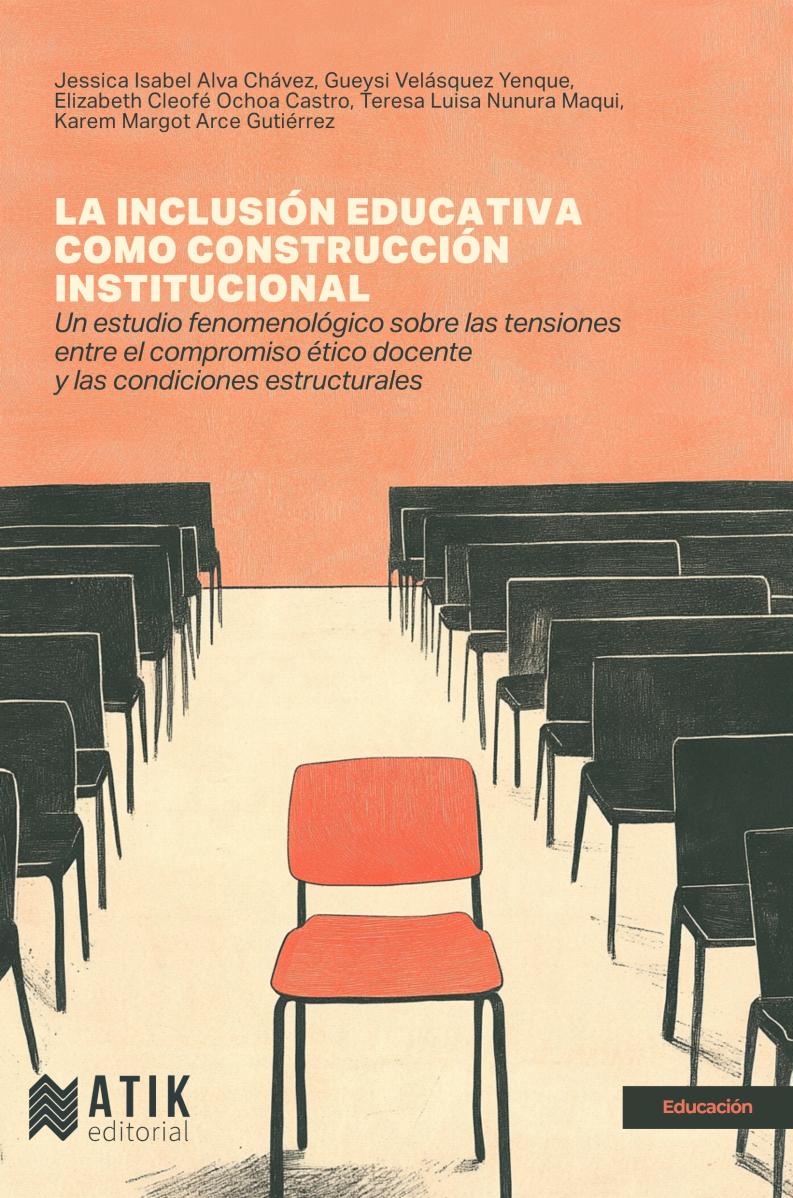
Inclusive education as an institutional construction. A phenomenological study on the tensions between teachers' ethical commitment and structural conditions.
Keywords:
Inclusive education, teacher perception, inclusive culture, educational policies, pedagogical practices, teacher voluntarism, symbolic inclusion.Synopsis
The inclusion of students with disabilities constitutes one of the most profound challenges facing contemporary educational institutions. This book explores how teachers perceive, interpret, and experience inclusion in their daily work, revealing the tensions between educators' ethical commitment and the structural, formative, and political limitations that hinder its consolidation. Through teachers' voices, the inclusive cultures, policies, and practices that shape school life are examined, highlighting both the progress achieved and the persistent gaps. The analysis leads to the identification of a central phenomenon: voluntarism-dependent inclusion, understood as that fragile form of inclusion that rests almost exclusively on the ethical-personal commitment of teachers, without institutional guarantees to sustain it over time. The work invites reflection on the need to move beyond reliance on individual effort and advance toward institutional conditions that make inclusion a sustainable, equitable, and truly transformative practice for all students.
Downloads
Download data is not yet available.
References
Aguilar Parra, J. C., Reasco Garzón, B. C., & Coello Vásquez, V. J. (2024). La inclusión educativa en la educación superior: Desafíos y perspectivas en Ecuador. Revista IncaCom, 4(2), 1–13.
Ainscow, M. (2005). Desarrollo de escuelas inclusivas: Ideas, propuestas y experiencias para mejorar las instituciones escolares. Narcea.
Ainscow, M., Booth, T., & Dyson, A. (2006). Improving schools, developing inclusion. Routledge.
Ainscow, M., & West, M. (2008). Mejorando las escuelas urbanas: Liderazgo y colaboración. Narcea.
Alulima, L., Mena, L., & Guevara, E. (2021). Construcción y validación del cuestionario de percepción de docentes sobre discapacidad intelectual y aprendizaje. Retos, 44, 167–175.
Ávalos, B. (2011). Teacher professional development in teaching and teacher education over ten years. Teaching and Teacher Education, 27(1), 10–20.
Ávalos, N., & Ordaya, E. (2021). Percepciones de docentes de un colegio limeño sobre las dificultades de aprendizaje del braille en niñez con discapacidad visual. Revista Electrónica Educare, 25(3), 1–21.
Booth, T., & Ainscow, M. (2000). Index for inclusion: Developing learning and participation in schools. CSIE.
Covarrubias, P. (2019). Barreras para el aprendizaje y la participación: Una propuesta para su clasificación. Dilemas Contemporáneos: Educación, Política y Valores, (3).
Culque, C., Gonzabay, N., & Rentería, A. (2024). Percepción de los docentes sobre la educación inclusiva y el alumnado con necesidades de educación especial (NEE). Revista Electrónica Interuniversitaria de Formación del Profesorado, 27(2), 81–96.
Delgado-Ramírez, J. C., Valarezo-Castro, J. W., Acosta-Yela, M. T., & Samaniego-Ocampo, R. D. L. (2021). Educación inclusiva y TIC: Tecnologías de apoyo para personas con discapacidad sensorial. Revista Tecnológica-Educativa Docentes 2.0, 11(1), 146–153.
Echeita, G., & Ainscow, M. (2011). La educación inclusiva como derecho: Marco de referencia y pautas de acción para el desarrollo de una revolución pendiente. Tejuelo, (12), 26–46.
Fernández, M., & Echeita, G. (2021). Desafíos sociales y educación inclusiva. Acción y Reflexión Educativa, 46, 80–106.
Hammalil, Y., Álvarez, J., & Molina, J. (2024). Estudio de la percepción del profesorado de Educación Secundaria hacia el alumnado con bajo desempeño funcional. Contextos Educativos. Revista de Educación, 34, 107–130.
Hernández Sampieri, R., Fernández Collado, C., & Baptista Lucio, P. (2014). Metodología de la investigación (6.ª ed.). McGraw-Hill.
Hernández, R., & Mendoza, C. (2018). Metodología de la investigación: Las rutas cuantitativa, cualitativa y mixta. McGraw-Hill.
Instituto de Estadística de la UNESCO. (2022). Global education monitoring report 2022. UNESCO.
Lipsky, D., & Gartner, A. (1996). Inclusion, school restructuring, and the remaking of American society. Harvard Educational Review, 66(4), 762–797.
Martínez, M. (2023). Percepción docente sobre la educación inclusiva. CIENCIAMATRIA, 9(17), 133–144.
Ministerio de Educación del Perú. (2007). Educación inclusiva: Marco normativo y orientaciones. Minedu.
Ministerio de Educación del Perú. (2016). Currículo Nacional de la Educación Básica. Minedu.
Montes, J., & Montes, R. (2025). QualiNexus (Versión 1.0) [Software]. Universidad de San Martín de Porres.
Moustakas, C. (1994). Phenomenological research methods. Sage.
Ortiz, M. (2015). La percepción docente en la mejora de la formación. Revista Iberoamericana de Educación, 68, 101–118.
Perera, V. H. (1999). La percepción social: Aproximaciones teóricas. Revista de Psicología Social, 14(2–3), 145–158.
Pérez, L., Sánchez, S., Rabazo, M., & Fernández, M. (2023). Inclusión educativa de los estudiantes con discapacidad: Un análisis de la percepción del profesorado. Retos, 51, 1183–1193.
Pilozo Camposano, D. (2025). Formación docente en educación inclusiva: Revisión sistemática. Revista de Ciencias Sociales y Humanidades, 8(1), 34–52.
Pujolàs, P., & Lago, J. R. (2011). Aprendizaje cooperativo: Fundamentos, características y técnicas. CCS.
Resnik, D. B. (2020). What is ethics in research & why is it important? National Institute of Environmental Health Sciences.
Riveros, M. (2022). Actitudes docentes e inclusión educativa en Cusco. Revista Peruana de Investigación Educativa, 14(1), 67–84.
Rosero Calderón, E., et al. (2024). Actitudes docentes hacia la inclusión y condiciones institucionales. Revista Colombiana de Educación, 90, 145–163.
Seidman, I. (2006). Interviewing as qualitative research (3.ª ed.). Teachers College Press.
Ulloa, P. (2024). Percepción docente sobre inclusión de estudiantes neurodivergentes. Revista de Educación Especial, 25(2), 112–130.
UNESCO. (2017). Educación para los Objetivos de Desarrollo Sostenible: Objetivos de aprendizaje. UNESCO.
UNESCO. (2020). Inclusion and education: All means all [Informe de seguimiento de la educación mundial]. UNESCO Publishing.
Vega, E. O., et al. (2022). Percepción sobre la educación inclusiva en estudiantes y padres de familia de una institución educativa de Lima-Perú. Espacios, 43(07), 19–29.
Vigotsky, L. S. (1978). El desarrollo de los procesos psicológicos superiores. Crítica.
Published
October 1, 2026
Series
Copyright (c) 2026 Jessica Isabel Alva Chávez, Gueysi Velásquez Yenque, Elizabeth Cleofé Ochoa Castro, Teresa Luisa Nunura Maqui, Karem Margot Arce Gutiérrez

Details about the available publication format: PDF
PDF
ISBN-13 (15)
978-9907-820-16-4
Publication date (01)
2026-10-01
How to Cite
Alva Chávez, J. I., Velásquez Yenque, G., Ochoa Castro, E. C., Nunura Maqui, T. L., & Arce Gutiérrez, K. M. (2026). Inclusive education as an institutional construction. A phenomenological study on the tensions between teachers’ ethical commitment and structural conditions. Atik Editorial. https://doi.org/10.46652/atikbook39